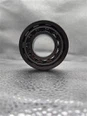
Bearing alloy
Bearing alloy (babbitt) is widely used. They usually have two types: tin based bearing alloy and lead based bearing alloy. They have the characteristics of fast running in and can easily make the surface very smooth. They are usually attached to the steel bearing pad matrix as bearing liners. Babbitt bearing has good adaptability, and has the characteristics of automatic adjustment for small misalignment or defective shaft. The proper amount of dust or foreign matters entering the lubricant can be absorbed by this soft material to prevent the shaft from being damaged by gluing, so this embeddedness makes them excellent bearing materials. The journal material can be mild steel, hard steel or cast iron.
bronze
Bronze bearings are suitable for low speed and heavy load situations with good shaft and bearing alignment. They can be made of a variety of alloy components to obtain various physical properties.
Lead copper
This kind of bearing has a higher bearing capacity than the bearing alloy, and its adaptability is poor, so it is used in the occasion where the shaft is rigid and neutral.
cast iron
Cast iron bearing materials are widely used in occasions where requirements are not too strict. The hardness of journal must be higher than that of bearing bush. The working surface shall be carefully run in with mixed resin of graphite and oil. It is required that the journal and bearing must be well aligned.
Porous bearing
The so-called "self-lubricating" or "porous" bearing can be made by sintering the metal powder and immersing it in oil. Bronze with different compositions is widely used in porous bearings, while iron is seldom used. Because porous bearing has self-lubricating property, it is mainly used in the situation where it is difficult or impossible to obtain reliable lubrication when using general lubrication methods.
Carbon and plastics
In high temperature occasions, or when traditional lubrication methods cannot be used, pure carbon bearings can achieve satisfactory results. Teflon is a very common plastic. The bearing made of it has extremely low friction coefficient, and is used in oil-free lubrication occasions. It can work under low speed or intermittent swing and heavy load conditions. Experiments show that some combinations of materials can work well, while others cannot. Material combinations that do not work well together will show excessive wear.