




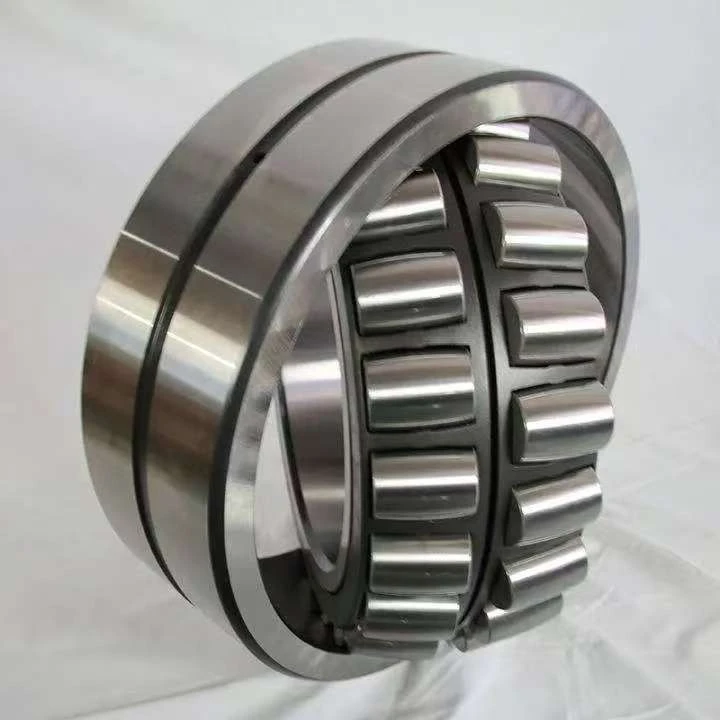
Self-aligning Roller Bearing For Vibrating Screen
I. Product Overview
Spherical Roller Bearings for Vibrating Screens are core transmission components customized for vibrating screen equipment. As key screening equipment in industries such as mining, building materials, and chemical engineering, vibrating screens operate under harsh conditions characterized by high-frequency vibration (amplitude 5-15mm, frequency 8-20Hz), heavy impact loads (instantaneous impact load up to 3-5 times the rated load), and high dust pollution. Ordinary bearings are prone to early wear, excessive temperature rise, and clearance failure. Through structural reinforcement, material upgrading, and sealing optimization, this product can effectively adapt to the eccentric shaft transmission system of vibrating screens, achieving the triple functions of "vibration resistance + self-alignment + wear resistance". It is a crucial foundational component ensuring the continuous and stable operation of vibrating screens.
II. Core Structure and Working Condition-Adapted Design
1. Targeted Structural Optimization
Aiming at the extreme working conditions of vibrating screens, the product has undergone five core upgrades based on traditional spherical roller bearings:
Reinforced Inner Ring Design: Adopts a "double rib + thickened wall" structure. The wall thickness of the inner ring is 15%-20% thicker than that of ordinary models, enhancing impact deformation resistance and preventing inner ring cracking caused by high-frequency vibration. Tapered bore models (with suffix K/K30) are compatible with the tapered shaft neck of the vibrating screen's eccentric shaft, and achieve interference fit with adapter sleeves to prevent wear caused by relative sliding between the bearing and the shaft.
Optimized Rollers and Raceways: Uses a combination of "barrel-shaped rollers + modified raceways". The roller generatrix is modified with a logarithmic curve to reduce edge stress concentration during vibration. The raceway surface undergoes ultra-precision grinding (roughness Ra ≤ 0.4μm) and phosphating treatment, improving surface hardness (HRC 60-62) and extending fatigue life.
Special Cage Design: Abandons ordinary stamped cages and adopts brass solid cages (Type CA) or high-strength nylon cages (Type TVPB). Brass cages are impact-resistant and high-temperature-resistant, suitable for heavy-duty vibrating screens; nylon cages are lightweight with a low friction coefficient (0.08-0.1), which can reduce inertial impact during vibration and are suitable for medium-light-duty vibrating screens.
Upgraded Sealing and Dust Prevention: Employs a composite design of "double-lip contact seal (2RS) + labyrinth dust-proof structure". The seal lip is made of nitrile rubber (NBR) or fluororubber (FKM), achieving an IP54 dust-proof rating. It can effectively block dust generated by screened materials from entering, avoiding abrasive wear of raceways.
Optimized Lubrication Channels: The outer ring is equipped with an annular oil groove and 3-4 oil holes (with suffix /W33). The oil holes are positioned corresponding to the roller contact area, facilitating regular replenishment of high-temperature grease (lithium-based grease or polyurea grease is recommended) to form a stable oil film and reduce temperature rise caused by dry friction.
2. Key Performance Advantages
Superior Vibration and Impact Resistance: Through the selection of materials (SUJ2 high-carbon chromium bearing steel or carburized steel) and heat treatment processes (integral quenching + low-temperature tempering), the impact toughness of the bearing is increased by 30%. It can withstand instantaneous impact loads during the operation of vibrating screens, preventing roller breakage or raceway spalling.
Efficient Self-Alignment Compensation: Allows a self-alignment angle of 1°-2.5°, which can compensate for shafting deviations (such as eccentric shaft bending and bearing housing installation errors) caused by long-term vibration of vibrating screens, avoiding local stress overload of the bearing and reducing the risk of early failure.
Stable Operation Over a Wide Temperature Range: After special heat treatment, the bearing exhibits excellent dimensional stability within the temperature range of -20℃ to +220℃. The rated dynamic load attenuation rate at high temperatures is ≤ 5%, adapting to the temperature rise environment of vibrating screens caused by friction (normal operating temperature 40-80℃).
Long-Life Design: By optimizing internal structural parameters (e.g., increasing the number of rollers by 10%-15% and adjusting the contact angle to 15°-20°), the basic rated life of the bearing is increased by more than 50% compared with ordinary spherical roller bearings. It can achieve 8,000-12,000 hours of maintenance-free operation on medium-sized vibrating screens.
III. Main Product Models and Selection Guide
1. Mainstream Product Models
According to the type of vibrating screen (circular vibrating screen, linear vibrating screen, high-frequency vibrating screen) and load level, common models are divided into the following series:
|
Product Model |
Structural Features |
Suitable Vibrating Screen Type |
Typical Application Scenarios |
|
222XX K/W33 + HXX |
Tapered bore + outer ring oil groove + adapter sleeve, brass cage |
Heavy-duty circular vibrating screen (processing capacity ≥ 100t/h) |
Mining limestone screening, coal classification |
|
230XX CA/W33 2RS |
Solid cage + composite seal + optimized lubrication, carburized steel material |
Linear vibrating screen (long screen surface) |
Building material sand screening, chemical raw material classification |
|
240XX CC/W33 TVPB |
Reinforced stamped cage + nylon cage, lightweight design |
High-frequency vibrating screen (fine-grain screening) |
Metal ore dressing screening, food industry classification |
|
223XX K30/2CS5 |
Taper ratio 1:30 + fluororubber seal, temperature and chemical resistance |
High-temperature vibrating screen (e.g., cement clinker screening) |
Cement industry clinker cooling screening, metallurgical sinter screening |
Note: "XX" in the model represents the inner diameter of the bearing (e.g., 22220 K/W33 indicates an inner diameter of 100mm). The adapter sleeve model (HXX) must match the inner diameter of the bearing (e.g., an inner diameter of 100mm is compatible with the H320 adapter sleeve).
2. Key Selection Parameters
Load Calculation: Calculate the radial load (usually 1.2-1.5 times the total weight of the equipment) based on the processing capacity of the vibrating screen and the weight of the eccentric block. Select a model with a basic rated dynamic load ≥ 1.3 times the calculated load.
Speed Matching: The rotational speed of the eccentric shaft of the vibrating screen is usually 500-1500r/min. Select a model with a limiting speed ≥ 1800r/min to avoid excessive temperature rise caused by high-speed operation.
Environment Adaptation: For scenarios with high dust levels, prioritize models with composite seals (2RS/2CS5); for high-temperature scenarios, select models with fluororubber seals and carburized steel materials; for humid environments, select models with anti-rust treatment (with suffix /2Z).
Installation Method: For eccentric shafts without shaft shoulders, select the tapered bore + adapter sleeve combination (K+H series) for easy installation and disassembly; for shafts with shaft shoulders, select cylindrical bore models (C/CC series) and use the shaft shoulder for positioning.
IV. Installation and Maintenance Guidelines
1. Installation Specifications
Pretreatment: Before installation, check for damage to the inner and outer rings and rollers of the bearing. Clean the surfaces of the bearing housing and shaft neck (roughness Ra ≤ 1.6μm) to remove burrs and oil stains. When matching tapered bore bearings with adapter sleeves, apply anti-rust oil to the tapered surface to avoid seizing.
Installation Method: Adopt hot fitting (heating temperature 80-120℃, not exceeding 150℃) or cold fitting (using a press). Avoid local overheating of the bearing during hot fitting. When installing the adapter sleeve, fasten the lock nut according to the specified torque (e.g., the torque for an M48 nut is 350-400N·m) to ensure proper interference fit. After installation, measure the radial clearance, which must meet the equipment requirements (usually 0.15-0.3mm).
Positioning Adjustment: After installation, check the axial runout of the bearing (should be ≤ 0.1mm) and adjust the coaxiality of the bearing housing and the eccentric shaft to avoid additional stress on the bearing due to installation deviations.
2. Maintenance Management
Lubrication Maintenance: After installing a new bearing, fill 30%-50% of the bearing's internal space with grease. Replenish grease every 20 hours during the initial operation period (within 100 hours), and then every 500-800 hours thereafter. For high-temperature or high-dust working conditions, shorten the lubrication cycle. The replenishment amount should be such that grease slightly overflows from the seal lip.
Condition Monitoring: Regularly (1-2 times a week) check the bearing temperature (normal temperature ≤ 80℃; shut down for inspection if exceeding 90℃), vibration value (measured with a vibration meter, acceleration ≤ 15m/s²), and abnormal noise. If a sudden temperature rise, abnormal vibration, or abnormal noise is detected, disassemble and inspect the wear of the raceways and rollers.
Replacement Cycle: When the bearing reaches 80% of its rated life, it is recommended to prepare a new bearing for replacement. During replacement, check the wear of the bearing housing (inner hole roundness error ≤ 0.01mm) to avoid early failure of the new bearing due to bearing housing wear.
V. Summary of Product Advantages
Precise Adaptation to Working Conditions: Designed specifically for the core working conditions of vibrating screens, such as high-frequency vibration, heavy impact, and high dust, to avoid early failure of ordinary bearings and reduce equipment failure rates.
Stable and Reliable Operation: Combined sealing, reinforced structure, and wide temperature performance ensure that bearings can operate stably for a long time in harsh environments, reducing downtime for vibrating screens and improving production efficiency.
Optimized Maintenance Costs: Long-life design and convenient installation structure reduce the frequency of bearing replacements and labor costs, while minimizing material loss due to bearing failure.
Flexible Model Selection: Covers various types of vibrating screens and load requirements, providing customized solutions (such as special materials, sealing structures), to meet individual application scenarios.
Hot Tags: self-aligning roller bearing for vibrating screen, China self-aligning roller bearing for vibrating screen manufacturers, suppliers, factory
You Might Also Like
Send Inquiry