




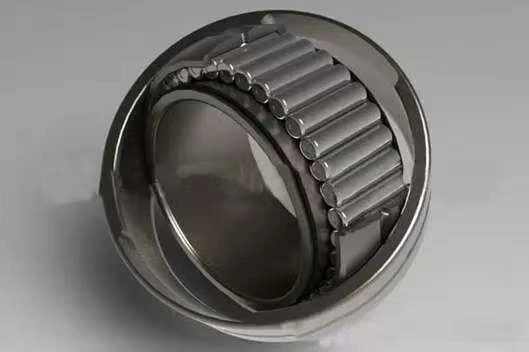
Basic Type Spiral Roller Bearing
Basic spiral roller bearings are radial bearings with spiral rollers as the core rolling elements. Specifically designed to withstand heavy loads, impact loads, and vibrational operating conditions, they achieve stable load-bearing through line contact between the rollers and the raceways of the inner and outer rings, while also featuring good self-aligning capabilities (for some models). Their core value lies in maintaining long service life and high reliability under harsh working conditions (such as dust, impact, and heavy loads). Widely used in heavy industrial fields including mining machinery, metallurgical equipment, and heavy-duty trucks, they are key supporting components in modern heavy-load transmission systems.
1. Core Structure and Working Principle
(1) Typical Structural Components
Basic spiral roller bearings adopt the classic rolling bearing structure of "inner ring + outer ring + spiral rollers + cage", with each component specifically adapted to heavy-load requirements. Details are as follows:
Inner Ring and Outer Ring
Material: High-carbon chromium bearing steel (GCr15 or GCr15SiMn) is used, subjected to integral quenching, with a hardness of HRC60-62 to ensure wear resistance and deformation resistance under heavy loads. For large-sized models (inner diameter ≥ 100mm), carburized bearing steel (20CrNiMo) can be used to enhance surface hardness (HV800-1000) and core toughness (impact toughness ≥ 15J/cm²), adapting to impact conditions.
Raceway Design: Both the outer circumference of the inner ring and the inner circumference of the outer ring are machined with arc-shaped raceways (curvature radius is 1.05-1.1 times the roller radius). The raceway surface undergoes ultra-precision grinding with a roughness of Ra ≤ 0.4μm, ensuring good contact between the rollers and the raceways. Some models feature a slight crown on the outer ring raceway to reduce edge stress concentration.
Spiral Rollers
Structural Characteristics: Made of spring steel (60Si2MnA) or bearing steel through cold rolling, spiral forming, and quenching. They have a spiral hollow structure with uniform pitch (tolerance ≤ 0.1mm). The length-to-diameter ratio (L/D) of the rollers is usually 2-4 to meet the requirement for a large contact area. Both ends of the rollers are designed with flat heads or arc chamfers (R0.2-R0.5mm) to avoid scratching the raceways during assembly.
Performance Advantages: The spiral structure endows the rollers with a certain degree of elasticity (radial deformation 0.01-0.03mm), which can cushion impact loads and vibrations. The hollow design reduces the roller weight (15%-20% lighter than solid cylindrical rollers), lowering centrifugal force during high-speed operation. Meanwhile, it facilitates the penetration of lubricating oil, improving lubrication effectiveness.
Cage
Material and Structure: Mainstream cages are made of stamped steel plates (SPCC or Q235) through forming and spot welding, with a comb-like or wavy structure. Some heavy-load models use brass cages (H62 brass) to enhance strength and wear resistance. The pocket size accuracy of the cage reaches IT9 grade, and the fit clearance with the rollers is controlled at 0.05-0.1mm to ensure uniform distribution of the rollers and avoid noise caused by movement.
Functional Role: In addition to separating the rollers, some cages are equipped with guide flanges that cooperate with the inner or outer ring to achieve "guiding positioning", preventing roller deviation under impact conditions and improving operational stability.
(2) Working Principle
When the bearing bears a radial load, the spiral rollers roll between the raceways of the inner and outer rings, and the load is evenly transmitted to the inner and outer rings through line contact between the rollers and the raceways. The spiral structure of the rollers can disperse local impact loads to the entire contact area, reducing the load per unit area (20%-30% lower than that of cylindrical roller bearings of the same size). At the same time, the elastic deformation of the rollers can absorb part of the vibration, reducing the transmission of vibrations during equipment operation. For self-aligning basic models (such as the 2000 series), the outer ring raceway is designed in a spherical shape, allowing a small amount of deflection between the inner and outer rings (self-aligning angle ≤ 2°) to compensate for installation deviations or shaft deflection, avoiding bearing failure due to misalignment.
2. Core Performance Advantages
Compared with cylindrical roller bearings and self-aligning roller bearings of the same size, basic spiral roller bearings have significant advantages under heavy-load and harsh working conditions. The core highlights are as follows:
Superior Load-Bearing Capacity
The radial rated dynamic load is 15%-30% higher than that of cylindrical roller bearings of the same size (e.g., a basic spiral roller bearing with an inner diameter of 50mm has a rated dynamic load of 80-120kN, while a cylindrical roller bearing of the same size has a rated dynamic load of approximately 60-90kN). It can withstand short-term impact loads of 1.5-2 times the rated load, adapting to heavy-load equipment such as mining machinery and rolling mills.
Good Load Uniformity: The line contact length between the spiral rollers and the raceways is 10%-15% longer than that of cylindrical rollers, with a low contact pressure per unit area (≤ 3000MPa), reducing raceway wear and extending service life.
Excellent Impact and Vibration Resistance
The elastic structure of the spiral rollers can absorb impact energy (impact absorption ≥ 5J). Compared with rigid cylindrical roller bearings, their service life can be increased by 2-3 times under impact conditions (such as ore crushing by crushers).
Low Operational Vibration: Due to the good contact between the rollers and the raceways and the elastic cushioning effect, the vibration velocity of the bearing during operation is ≤ 2.5mm/s (approximately 3-4mm/s for cylindrical roller bearings of the same size), reducing equipment noise (noise level ≤ 85dB).
Good Adaptability to Working Conditions
Strong Contamination Resistance: The spiral gaps of the spiral rollers can accommodate a small amount of dust and impurities (particle size ≤ 0.1mm), avoiding premature failure caused by impurity jamming of the rollers and adapting to dusty scenarios such as mining and metallurgy. Some models can be equipped with contact seals (nitrile rubber) to further improve dust-proof performance.
High Lubrication Fault Tolerance: The hollow spiral structure facilitates the storage and penetration of lubricating oil. Even if lubrication is insufficient (e.g., a 30% reduction in lubricating oil volume), it can still maintain normal operation for a short period, reducing maintenance requirements.
Long Service Life and High Reliability
Long Rated Service Life (L10): Under rated load, the service life of basic spiral roller bearings can reach 10,000-20,000 hours, which is 20%-40% longer than that of self-aligning roller bearings under the same working conditions. For large-sized bearings used in mining machinery (inner diameter ≥ 200mm), the service life can even exceed 30,000 hours, matching the overhaul cycle of heavy equipment.
Low Failure Risk: The spiral structure reduces sudden failure modes such as roller fracture and jamming, with a failure probability only 1/3 that of cylindrical roller bearings, improving equipment operational stability.
3. Classification and Common Models
Based on structural differences, basic spiral roller bearings can be divided into two categories: "ordinary type" and "self-aligning type". The model naming follows national standards (GB/T 307.1) or international standards (ISO 15). Common classifications and models are as follows:
Ordinary Basic Spiral Roller Bearings (Non-Self-Aligning)
Structural Features: Both the inner and outer ring raceways are cylindrical, with no self-aligning capability, suitable for scenarios where the coaxiality between the shaft and the bearing housing is good. They usually have no sealing structure and need to be used with external seals.
Common Models: Such as Type N (cylindrical inner ring without ribs), Type NU (cylindrical outer ring without ribs), and Type NJ (cylindrical inner ring with single rib). Typical models include N310 (inner diameter 50mm, outer diameter 110mm, width 27mm) and NU315 (inner diameter 75mm, outer diameter 160mm, width 37mm), which are suitable for stable heavy-load scenarios such as motors and reducers.
Self-Aligning Basic Spiral Roller Bearings
Structural Features: The outer ring raceway is spherical (the center of curvature coincides with the bearing center), and the inner ring and roller assembly can deflect slightly relative to the outer ring (self-aligning angle ≤ 2°) to compensate for installation deviations or shaft deflection. Some models are equipped with stamped steel cages or brass cages, adapting to scenarios with large vibrations.
Common Models: Represented by the 2000 series, such as 22210 (inner diameter 50mm, outer diameter 90mm, width 23mm) and 22315 (inner diameter 75mm, outer diameter 160mm, width 55mm), which are widely used in equipment with installation deviations such as mining crushers and vibrating screens.
4. Typical Application Scenarios and Cases
The application scenarios of basic spiral roller bearings focus on the "heavy load + harsh working conditions" field, covering multiple heavy industrial industries. Typical scenarios are as follows:
Mining Machinery Field
Application Positions: Crusher main shafts, ball mill bearing housings, conveyor drum shafts
Working Condition Requirements: Withstand heavy loads (radial load 100-500kN), impact loads (short-term peak 2-3 times the rated load), and high dust levels (dust concentration ≥ 50mg/m³), requiring a bearing service life of ≥ 8000 hours
Suitable Models: Self-aligning Type 22324 (inner diameter 120mm, rated dynamic load 480kN), Ordinary Type NU328 (inner diameter 140mm, rated dynamic load 520kN)
Application Case: The main shaft of a mining crusher adopts the self-aligning basic spiral roller bearing Type 22324. Compared with the previously used self-aligning roller bearings, the service life is increased from 5000 hours to 12,000 hours, and the equipment failure rate is reduced by 40%.
Metallurgical Equipment Field
Application Positions: Rolling mill work rolls, continuous caster rollers, steel converter trunnions
Working Condition Requirements: High-temperature environment (operating temperature 80-120℃), heavy loads (radial load 200-800kN), and large vibrations (vibration acceleration ≥ 10m/s²), requiring bearings to be high-temperature resistant and impact resistant
Suitable Models: High-temperature resistant Type 22230 (using high-temperature grease, temperature resistance 150℃), Heavy-duty Type NU430 (inner diameter 150mm, rated dynamic load 780kN)
Application Case: The work roll of a steel mill rolling mill adopts the basic spiral roller bearing Type NU430. Combined with graphite grease, it operates continuously for 15,000 hours without failure under high temperature (120℃) and radial load (300kN), meeting the continuous production requirements of the rolling mill.
Heavy-Duty Truck and Construction Machinery Field
Application Positions: Heavy-duty truck drive axles, loader gearboxes, excavator travel mechanisms
Working Condition Requirements: Intermittent heavy loads (load up to 1.8 times the rated value during startup), bumpy vibrations (frequent vibrations caused by complex road conditions), and limited space (requiring a compact structure)
Suitable Models: Compact Type N320 (inner diameter 100mm, outer diameter 215mm, width 47mm), Self-aligning Type 22220 (inner diameter 100mm, outer diameter 180mm, width 46mm)
Application Case: The drive axle of a heavy-duty truck adopts the self-aligning basic spiral roller bearing Type 22220. Under full load (49 tons) and mountain road bumpy conditions, the bearing service life reaches 150,000 kilometers, which is 50% longer than that of the previously used tapered roller bearings.
General Heavy Machinery Field
Application Positions: Input/output shafts of large reducers, port crane wheel shafts, paper machine press rolls
Working Condition Requirements: Stable heavy loads (radial load 50-200kN), long-term continuous operation (annual operating time ≥ 8000 hours), requiring bearings to be low-maintenance and long-life
Suitable Models: Ordinary Type NJ318 (inner diameter 90mm, rated dynamic load 320kN), Self-aligning Type 22318 (inner diameter 90mm, rated dynamic load 420kN)
Application Case: The wheel shaft of a port crane adopts the self-aligning basic spiral roller bearing Type 22318. Combined with regular lubrication (grease replenishment every 500 hours), it operates continuously for 20,000 hours without maintenance, significantly reducing the downtime of port equipment.
Hot Tags: basic type spiral roller bearing, China basic type spiral roller bearing manufacturers, suppliers, factory
You Might Also Like
Send Inquiry